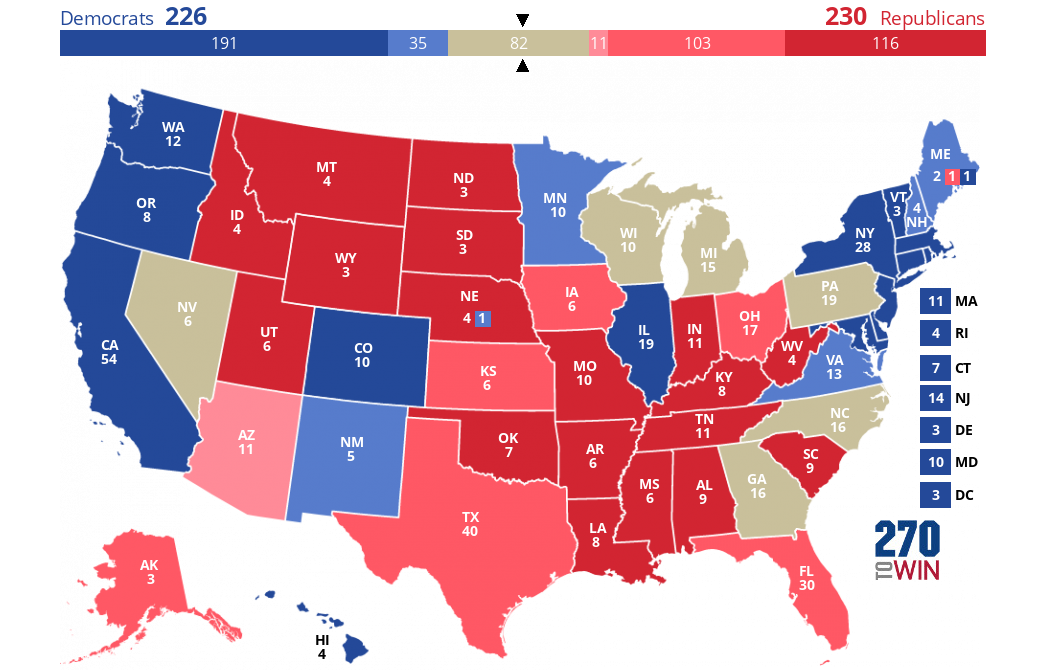
2012 Presidential Election Polls


While it may come as a surprise since Election Day was about two months ago, Barack Obama and Joe Biden were not officially re-elected until today (January 4), when the electoral vote results of each state (certified by the Electors) were read and tabulated in Congress.    There were no surprises:  The final tally was Obama 332, Romney 206 for President;  Biden 332, Ryan 206 for Vice-President.     For those interested in the process of getting from the vote on Election Day to today, this article from the National Archives website provides a high-level summary.     That narrative specifies January 6th as the date for the count in Congress; we’re assuming it was changed to today because the 6th is a Sunday.

The final popular vote totals were 65,899,660 for Obama-Biden (51.1%) and 60,932,152 (47.2%) for Romney-Ryan.   Visit our states area to see the 2012 popular vote percentages, and compare those to the prior 4 elections.  (Note that the very bottom part of these pages are not yet updated for 2012.)

**  In the weeks ahead, we’ll be updating the site (and our iPad App) to let you start creating and sharing 2016 electoral maps.    Since both parties will have new nominees, the updates will allow you to create specific Democratic and Republican match-ups. **


{ 7 comments }

America’s Electoral Map Contest:  There were 34,342 valid entries to the contest,  15,856 entrants (one entry per day was allowed) and 5,534 unique map configurations uploaded.   The most commonly submitted map was the correct map, and was submitted 2,307 times.    The first three of these perfect entries came within an hour of the start of the contest.   In the end, this election didn’t deliver any major surprises, so we expected to have quite a few perfect guesses.    In addition to the first perfect map winner, we’ll be randomly selecting 3 entries this week from the remaining group of perfect entries, as per the official rules.     If any of these selections are deemed not eligible to receive a prize, a substitute winner will be selected and notified.   For those that don’t win, please see the official rules for how to request a list of winners.


2012 Results:    We’ll be updating the site over the next couple months to reflect the final 2012 presidential election results.  These are not technically official until the Electors vote and the states submit their popular vote totals in December.  We’ll also begin to set the map and site up for those of you that want to begin to look ahead to 2016.

{ 68 comments }

This table shows the last time a party’s nominee won the presidential election while losing a specific battleground state.    To see the year for other states, or to find out other trivia, see 270toWin Answers.

State Democrat Republican
Colorado 1996 1908
Florida 1992 1924
Iowa 1976 2000
Michigan 1976 2004
Nevada 1976 1908
New Hampshire 1976 2004
North Carolina 1996 1956
Ohio 1960 NEVER
Pennsylvania 1948 2004
Virginia 1996 1924
Wisconsin 1960 2004

{ 109 comments }

Update October 24, 2012:   We’ve created a new Electoral College Tie Finder that will let you play around with any combination of 11 battleground states.   We’re planning to add 2nd District in Maine and Nebraska (one electoral vote each) to this in the next couple days, as what limited polling there is shows both are pretty competitive.

Update September, 2012:    The post below was originally written in advance of the 2008 election.   We’ve updated the relevant dates for the 2012 election.    Separately, a few people have asked which candidate would win the presidency should the vote go to the House.   Based on a review of the current race ratings underlying our 2012 House Elections Map, Republicans would have control in 26 states, Democrats 11.   The remaining 13 states are too close to tell.    Note that this is based on ‘safe’ and ‘likely’ races being allocated to a party.   If this were to play out, Romney would have the advantage in a tie scenario.

What are the most likely ties?  For those curious about actual tie combinations for 2012, there are 32 of them if we assume 11 battleground states (FL, PA, OH, MI, NC, VA, WI, CO, NV, IA, NH).     Some don’t think MI and PA are true battlegrounds.  We’ll let the voters decide, but just for purposes of the example, if we remove those, we are left with 5 tie scenarios.   Finally, if we give NC to Romney and WI to Obama, we’re left with 7 states (FL, OH, VA, CO, NV, IA, NH) and a 247-206 Obama lead.      If it plays out this way, there are two tie scenarios remaining.   In the first,   Romney wins all but VA and CO.   In the second, he wins all but OH and NH.     You can use the ‘Road to 270′ feature, which appears below the map on the home page, to see all tie scenarios associated with your own election forecast.

==

Another close election may be coming up in November. It is not difficult to create a realistic scenario where the electoral map on election night is 269-269. What then?

As our site URL says, it takes “270 to Win”. If neither candidate gets a majority of the Electoral Votes, the election for President is decided in the House of Representatives, with each state delegation having one vote. Senators would elect the Vice-President.

It is important to note that an apparent tie on election night does not mean that there is actually a tie.The actual Electors meet on the first Monday after the second Wednesday in December (December 17, 2012 15, 2008 ) to cast their votes.Only about half the states have laws requiring their Electors to vote for the popular vote winner.It is possible that an Elector could cast his or her vote for another person.As long as that vote wasn’t for the other major candidate in the race, this wouldn’t be an issue — neither candidate would have 270.However, imagine a scenario where a single Elector in a single state switched their vote to the other party — the vote would be 270 -268.While very unlikely, it has happened before (most recently in 1968, although the election that year wasn’t close).If you thought the 2000 election was controversial, this outcome just might bring the Electoral College system to its knees.

More than likely, the election would remain undecided after the Electors voted.The new Congress meets in joint session on January 6, 2013 2009 to count the electoral votes (this count happens whether the election is close or not).If neither candidate has reached 270 Electoral Votes, then the House and Senate take over and elect the President and Vice-President, respectively.

UPDATE 6/22:   Based on some feedback, we may not have made this point clearly enough:  It is the new Congress, that is inaugurated the first week of January, 2013 2009, that will have the responsibility of breaking any ties.

{ 339 comments }

Below the electoral map on our site, there’s a feature you may have seen called “The Road to 270″.     This feature calculates the number of ‘critical path’ combinations to 270 that remain for either party based on the undecided states in your map, as well as any possible tie combinations.   It updates automatically each time you change the status of a state.

By critical path, we mean those combinations that are available to cross the required 270 electoral votes threshold.   To take a simple example, let’s say Obama has 262 electoral votes on your map, and the only two undecided states are Virginia (13 electoral votes) and New Hampshire (4 electoral votes).   While there are two overall combinations there (VA or VA+NH), only one of them is relevant to our goal of 270.  Put another way, if you were managing the Obama campaign in this scenario, how much resource would you devote to winning New Hampshire?

The new features include the following:

  • Must Win for 270:    Displayed separately, these are any states that, if lost, would give the other candidate to 269 or more electoral votes.   Therefore any states in this category will be required in every critical path to 270.
  • Not Needed for 270:   Displayed separately, these are states that are not required in any critical path, like New Hampshire in the earlier example.
  • Filtering:   For all the states not fitting into one of the above two categories, we now display the number of combinations that include that state.  You can check one or more states to filter to only those paths that include all the checked states.
  • Totals:  The total electoral votes associated with each combination are shown
  • Probability:  The combinations are ordered by probability of occurring (based on polling averages).   Note that probability doesn’t necessarily mean “probable”.  For example, if Obama has 268 electoral votes on your map, and the states remaining are Montana and Kentucky, Montana will appear higher than Kentucky on the list, but we’re talking about “improbable” in the case of Montana, and “extremely unlikely” in the case of Kentucky.    Note also that when dozens of combinations remain, with multiple states in a combination, almost any single specific path is going to have a low probability, particularly if it involves toss-up states.

The Road to 270 also calculates tie scenarios that are possible with your map.   Every remaining state is involved in a tie scenario, of course.   The Ties page shows each possible tie scenario and how the states break out between Obama and Romney.   These tie scenarios are not in any particular order at this time.

The Road to 270 feature appears when 12 or fewer states remain undecided on your map and neither candidate has reached 270 electoral votes.

{ 98 comments }

Probability of 270 Electoral Votes

June 19, 2012

We’ve relaunched  ”The Probability of 270″ to the interactive electoral college map page.   This feature works in tandem with your maps, as you create them, to tell you the probability that either candidate will reach 270 electoral votes based on the remaining states undecided on your map.    The calculated probabilities for each state are [...]

Read the full article →

Toss Up States June 1 Update

June 1, 2012

For background on this, see this Swing States Update post.  The current toss up map is here; 10 states remain in the toss up category based on the criteria of being listed as a toss up by one or more of 4 professional pundits. NBC and Cook Political have made some race ratings changes this [...]

Read the full article →

Swing States Update

April 26, 2012

**May 16 Update** A couple weeks back, the New York Times came out with their battleground state analysis.   Wisconsin was included in that list.    Given this plus recent polling which shows the race basically tied, we’ve added the Times as a 4th resource (see post below) and moved Wisconsin into the toss-up category [...]

Read the full article →

Super Tuesday

March 1, 2012

Summary of Results:   Times displayed below are Eastern time. 7PM:  Polls close in Georgia, Virginia and Vermont.   Per NBC:  Gingrich has won Georgia and Romney has won Virginia and Vermont. 7:30PM:   Polls close in Ohio.  Romney has won Ohio. 8PM:   Polls close in Massachusetts, Oklahoma and Tennessee.  Romney has won Massachusetts, Santorum [...]

Read the full article →

Go Big or Go Home

February 21, 2012

An interesting historical fact as we move closer to the 2012 election: Every president re-elected for a 2nd term*, except Wilson in 1916 won more electoral votes the 2nd time around. On the other hand, most presidents who run for re-election and lose get beaten soundly in the process.  Looking at those occurrences since 1900: [...]

Read the full article →

Copyright © 2004-2013 270towin.com All Rights Reserved